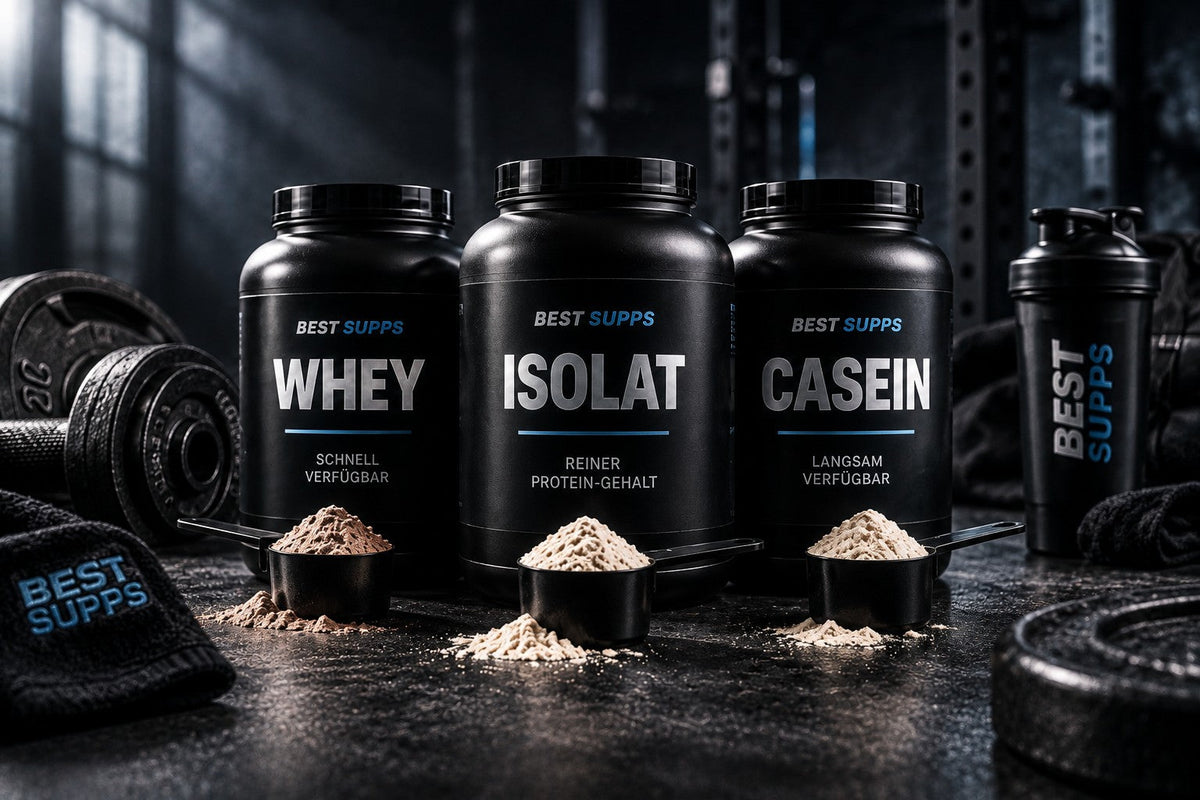
Standing in front of a shelf—or browsing a shop—almost everyone eventually faces the same question: Whey, Isolate, or Casein? The tubs look similar, the prices differ significantly, and the promises on the front are rarely helpful. Yet the answer is less complicated than it seems: these varieties differ primarily in processing, digestion speed, and composition. Once you understand these three points, you will know which protein suits you best.
The Starting Point: What Protein Does
All the powders discussed here provide the same basic product—protein. Health claims are permitted for proteins in the EU, which we repeat in their exact wording: Proteins contribute to an increase in muscle mass and proteins contribute to the maintenance of muscle mass. These claims apply when a product meets the necessary requirements—the nutrition table shows how much protein is actually contained per serving.
The differences between the types, therefore, lie not in whether they provide protein, but how they do it. How much total protein you need per day is clarified in our foundational article Protein: The Key to Muscle Building.
Whey, Isolate, and Casein in Direct Comparison
The most important differences at a glance:
| Feature | Whey Concentrate | Whey Isolate | Casein |
|---|---|---|---|
| Protein content | approx. 70–80% | approx. 85–90% and more | approx. 80% |
| Lactose content | higher | very low | low to medium |
| Digestion | fast | fast | slow |
| Consistency | creamy, full-bodied | lighter, thinner | thick, satiating |
| Price per serving | most affordable | higher | medium |
| Typical use | everyday, standard | diet phase, avoiding lactose | evening, long-lasting satiety |
Not in the table, but worth mentioning: Clear Whey and Hydrolysate are both whey-based variants—more on those below.
Whey Protein (Concentrate) – The Standard
Whey is whey protein, a byproduct of cheese production. With concentrate, the whey is filtered and dried without being highly purified. The result is a powder typically containing around 70–80% protein, which contains small amounts of milk sugar and milk fat in addition to the protein. Compared to the more heavily filtered isolate, more of the natural accompanying substances remain here.
This is precisely why concentrate is the favorite for many: the remaining components provide a fuller taste and a creamier consistency—and it is the most affordable of the three varieties. If taste and price are more important than maximum purification, this is the obvious choice.
Whey protein is also considered a high-quality protein source: its biological value is given as approximately 104 , and it contains more leucine compared to casein .
Suits you if: you want an uncomplicated standard solution, are watching your budget, and tolerate lactose well. You can find the selection under Whey Protein.
Whey Isolate – The Purified Relative
With isolate, the filtration goes a step further. Fat and milk sugar are largely removed, increasing the protein content to about 85–90% or more. Per serving, you get more protein with fewer accompanying substances—and significantly less lactose.
The price for this has a double meaning: isolate costs more, and the more intense taste of the concentrate is partially lost through the purification. Many describe isolate as lighter and thinner. For people who do not tolerate milk sugar well, or for those who want as much protein as possible with few calories during a calorie-conscious phase, this is exactly the advantage.
Suits you if: you want to avoid lactose, are in a diet phase, or are looking for the highest protein content per serving. See Whey Isolate.
Casein – The Slow Protein
Casein is the second major protein component in milk, making up about 80% of its proteins . It is the exact counterpart to whey: while whey protein is digested quickly, casein forms a gel-like structure in the stomach and releases its amino acids over a significantly longer period .
Practically speaking: casein is thicker, is noticeably more satiating for many, and is therefore often used as part of an evening meal or as a filling snack in between. Compared to whey, it also contains more calcium . It is not a "better" protein than whey—it simply has a different profile.
Suits you if: you are looking for a more satiating protein source or want something creamier in the evening. Selection: Casein.
Clear Whey and Hydrolysate – Two Special Forms
Clear Whey is an isolate processed to dissolve clearly and juice-like instead of milky. Instead of chocolate and vanilla, there are flavors like fruit punch or lemon. Anyone tired of creamy shakes or who prefers something refreshing in hot weather will find a real alternative here—with a protein profile comparable to classic isolate. More on this under Clear Protein.
Hydrolysate is the third processing stage of whey protein. It is enzymatically pre-digested, meaning the protein chains are already split. It is the most expensive variant and often tastes slightly bitter—but it is particularly easily absorbed.
And if milk is not an option?
Whey, Isolate, Clear Whey, Hydrolysate, and Casein all originate from milk. Anyone wishing to avoid milk protein or who follows a vegan diet can turn to plant-based proteins—usually mixtures of pea, rice, or soy, which complement each other well in combination. A non-dairy animal alternative is Beef Protein. Depending on your diet, different types of protein are suitable; both paths provide protein, but they differ significantly from whey in taste and consistency.
Comparing Protein Content Correctly – With an Example
The percentage on the tub is the most common pitfall. "80% protein" sounds good, but only means something when you relate it to the serving size. Comparing two products:
- Concentrate: 30g serving with approx. 75% protein content → approx. 22g of protein per shake.
- Isolate: 30g serving with approx. 90% protein content → approx. 27g of protein per shake.
The five-gram difference sounds small, but adds up significantly over a whole tub—and also explains the price difference. Conversely: if a manufacturer increases the serving size (e.g., 40g instead of 30g), the protein value per serving automatically rises without the powder being any better. Therefore, always compare protein per 100g—only the same reference value makes two products truly comparable.
Timing: Does the timing matter?
Whey is digested quickly, casein slowly—this has led to the common rule that whey belongs around a workout and casein in the evening. As a rough guide, this is useful, but it should not be overestimated: the decisive factor is the total amount over the day, not the exact minute of consumption.
Practically, this means: use the properties where they benefit you. A quickly mixed whey shake is simply practical after training. A creamy casein in the evening is more satiating and replaces the trip to the fridge for many. Both are comfort arguments—and comfort is the reason why one sticks to a routine.
Which one suits you now? A brief guide for decision-making
- You want a good everyday protein at a fair price → Whey Concentrate.
- You do not tolerate lactose well → Whey Isolate or Clear Whey.
- You are in a calorie-conscious phase → Isolate (more protein, fewer accompanying substances).
- You are looking for something that satiates longer → Casein.
- Creamy shakes are too heavy for you → Clear Whey.
- You avoid dairy products → Vegan protein or Beef Protein.
And the most important point, which is often overlooked: what matters is not the perfect type, but that you achieve your protein amount throughout the day at all. A protein you enjoy and drink regularly beats every theoretically superior powder that sits in the cupboard unused.
What to look for when buying
Regardless of the type, it is worth looking at these same points:
- Protein per serving: The decisive number is in the nutrition table—not on the front.
- Serving size: Only in relation to the serving can two products be compared fairly.
- Ingredient list: Is it complete and understandable? Which sweeteners are included?
- Allergens: Whey, Isolate, Clear Whey, and Casein contain milk; plant-based powders often contain soy.
- Taste and solubility: Small containers or samples save you from the mistake of buying a large tub.
You can find an overview of all types bundled under Proteins.
Frequently Asked Questions
What is Whey Protein, actually?
Whey is whey protein—the water-soluble protein component of milk that arises during cheese production. It is filtered, dried, and offered as powder. "Whey" is simply the English word for Molke.
What is the difference between Whey and Isolate?
Isolate is more highly purified whey: more protein per serving, less lactose and fat, but more expensive and less full-bodied in taste.
Is Whey Protein vegan?
No. Whey is obtained from milk and is therefore not a vegan product. Those who live vegan turn to plant-based protein powders, such as pea, rice, or soy.
Is Whey Protein vegetarian?
Generally yes—dairy products are usually not problematic for vegetarians. For individual products, animal rennet may play a role; the information on the packaging will provide details.
Is Casein better than Whey?
No—the two are not better or worse, but different. Whey is digested quickly, casein slowly. Which is "better" depends solely on what you are using it for.
Can I combine Whey and Casein?
Yes. Some use whey around training and casein in the evening; others reach for a multi-component protein that already combines fast and slower protein sources. Just make sure that your total protein amount over the day matches your requirements.
Which protein is best for beginners?
For starting out, whey concentrate is usually the most obvious choice: affordable, uncomplicated in taste, and widely available. Those who cannot tolerate lactose should start directly with an isolate.
Is Whey Protein harmful?
For healthy adults, whey protein is considered a normal food—it is a milk component, not a special preparation. Stick to the product's consumption recommendations. In cases of existing conditions, particularly kidney issues, medication use, or pregnancy and breastfeeding, use should be clarified by a doctor beforehand. Whey is not suitable for those with a milk protein allergy.
Conclusion
Whey, Isolate, and Casein are not competitors, but three tools with different profiles: concentrate as a solid everyday standard, isolate for maximum protein content and low lactose, casein for long-lasting satiety. Clear Whey and Hydrolysate complement the selection as special forms. Choose what fits your tolerance, your phase, and your taste—and then stick with it.
A final note: The body reacts differently depending on individual tolerance, existing conditions, and total diet. The information here does not replace medical advice. Further basics can be found in the Best-Supps Magazine.