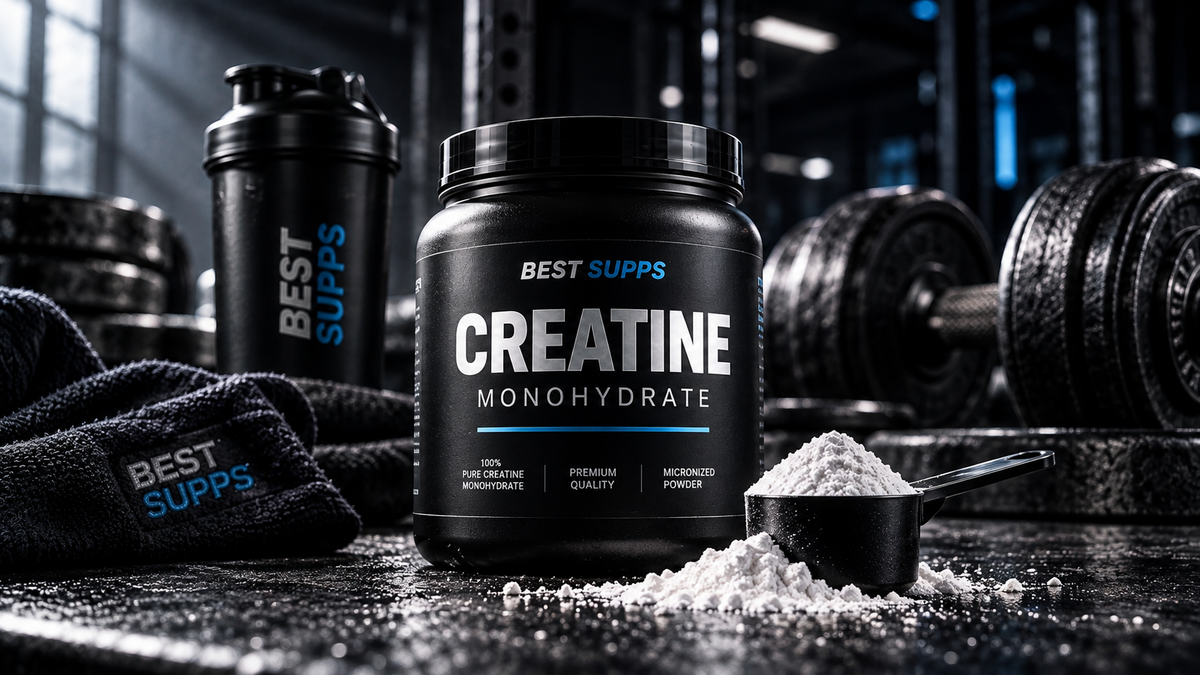
Creatine is the most thoroughly researched substance on the sports nutrition shelf and, at the same time, one of the few for which a health claim is approved in the EU. That is exactly why it is worth being able to read the information on the container: anyone who knows what the amount per serving is and how many servings a package provides can compare products in a minute rather than in twenty.
This article explains what creatine is, which claim is approved for it and under what conditions, how the forms differ, and how you can recognize a well-labeled product. Concrete figures from our product range can be found in the tables.
What is creatine?
Creatine is an endogenous substance that is formed from the amino acids glycine, arginine, and methionine. As a carbon-nitrogen compound, it is relevant for the rapid provision of energy. The body produces about one to two grams per day itself, the rest comes from food. The stores are mainly located in the skeletal muscle. There, it is present predominantly as creatine phosphate.
In food, creatine is primarily found in red meat and fish, roughly one to five grams per kilogram, although cooking can reduce the content; these are the most important sources of creatine. Plant-based foods contain practically none. Vegetarians and vegans therefore often have lower creatine stores. That is also the answer to a common question: Creatine as a dietary supplement is generally vegan because it is synthetically produced and does not come from animal raw materials. Whether a capsule shell consists of gelatin or cellulose is stated in the ingredient list.
The approved claim and its condition
For most substances in the sports nutrition shelf, no health claim is approved in the EU. Creatine is one of the exceptions. The approved wording according to Regulation (EU) 432/2012 is:
Creatine increases physical performance in successive bursts of short-term, high-intensity exercise.
These are the relevant facts regarding the approved claim; furthermore, creatine is not an anabolic steroid or hormone.
A manufacturer may only use this claim if the product provides at least 3 grams of creatine per day when consumed as intended. It is aimed at adults who perform high-intensity training. In this context, creatine is considered safe for healthy adults at recommended dosages; the effect of creatine is regulatorily limited to this specific statement here.
This is the one number you can use to check every package: amount per serving multiplied by servings per day. If the result is at least 3 grams of creatine, the condition is met, and the claim can specifically refer to this effect.
With creatine monohydrate, a conversion factor must be added because monohydrate contains crystal water and therefore does not consist 100 percent of creatine:
Calculation |
Value |
|---|---|
Creatine |
131.135 g/mol |
Creatine monohydrate |
149.150 g/mol |
Creatine content in monohydrate |
87.9 percent |
Monohydrate for 3 g of creatine |
3.41 g mathematically, rounded up to 3.42 g |
We always round up for a minimum value: 3.41 grams of monohydrate result in 2.998 grams of creatine and miss the condition by two milligrams.
What that means in practice: The standard serving of 5 grams of monohydrate provides around 4.4 grams of creatine and significantly fulfills the condition. A product with 3 grams of monohydrate per serving and one serving per day does not fulfill it.
How much creatine per day?
The recommended intake is on the package, and it is binding. The approved claim is linked to 3 grams of creatine daily; 5 grams of monohydrate per serving is standard in the market. 3 to 5 grams per day are therefore considered the standard dosage; in this range, creatine is considered safe if a tested supplement is used as recommended.
Regarding the question of a loading phase: two approaches are common, either a consistent daily amount or a higher-dosed initial phase over a few days. However, a loading phase is not absolutely necessary for creatine intake. Which of these is intended for taking creatine is stated in the recommended intake of the respective product. In supplementation, 20 grams daily is used at most as an optional loading phase; without it, the creatine stores are also filled after 3 to 4 weeks. Stick to it and do not exceed it, as overly high doses can cause gastrointestinal discomfort.
The creatine forms in comparison
Several forms stand side by side on the shelf. They differ in the creatine content per gram, and that is exactly what determines how much powder a serving requires; for comparability, therefore, it is not the name that counts, but above all the actual content per serving, because the creatine effect and its measurable impact also depend on that.
Form |
Creatine content |
Required for 3 g of creatine |
Note |
|---|---|---|---|
Monohydrate |
87.9% |
3.42 g |
the longest-used and best-researched form, to which most studies refer |
Creapure |
87.9% |
3.42 g |
Brand name for monohydrate from a German manufacturer, chemically identical |
Creatine HCl |
78.2% |
3.84 g |
better water-soluble |
Kre-Alkalyn |
buffered monohydrate |
Manufacturer's statement |
Content depends on the buffering, read the label |
Creatine Citrate 1:1 |
40.6% |
7.39 g |
Content varies depending on the 1:1, 2:1 or 3:1 ratio |
Creatine Malate |
depending on ratio |
Manufacturer's statement |
like citrate, the ratio belongs on the package |
How to check this: If the container only says "creatine complex" or a collective item without individual amounts, it is impossible to calculate how much creatine a serving provides. In that case, the basis for comparison is missing.
Incidentally, micronized does not designate a different form, but a finer grind. The powder dissolves faster, but the creatine content remains the same.
Pure monohydrate products in price comparison
All are available and provide around 4.4 grams of creatine at 5 grams per serving. The complete selection can be found at Creatin Monohydrat.
| Product | Package | Servings | Price | € per serving |
|---|---|---|---|---|
| Dedicated Nutrition Micronized Creatine Monohydrate | 500 g | 100 | 10.90 € | 0.11 € |
| CNP Creatine Monohydrate | 250 g | 50 | 9.90 € | 0.20 € |
| Warrior Creatine Monohydrate | 300 g | 60 | 11.90 € | 0.20 € |
| DY Nutrition Creatine Monohydrate | 300 g | 60 | 15.90 € | 0.27 € |
| Evolite Creatine Monohydrate | 500 g | 100 | 28.90 € | 0.29 € |
Creapure
Creapure is a brand name for creatine monohydrate from German production. Chemically, it is the same monohydrate with the same 87.9 percent creatine content; the difference lies in the origin and purity testing of the raw material. We currently carry a single Creapure product; those who value this raw material will find it listed in the ingredient lists of individual items under Creatin Monohydrat.
Powder or capsules, and why the price comparison shifts here
Powder and capsules contain the same substance. The difference lies in convenience and price per serving, and that is exactly where the comparison becomes inaccurate.
With powder, you calculate by grams, with capsules by piece. A capsule price of 0.10 euros per piece says nothing as long as it is not stated how many capsules make up one serving. Three capsules of 1 gram of monohydrate each are a serving of 3 grams, and that is just barely not enough to meet the condition.
The calculation that makes both comparable: Amount per serving, servings per package, package price divided by servings. Only this price per serving can be compared.
Price per serving: Figures from our range
All of the following information calculates with the market-standard serving of 5 grams of powder.
Across the 28 available creatine powders in our range, the price per serving ranges from 0.11 to 0.72 euros, six times as much for the same substance. Flavored versions and combination products are systematically higher because part of the powder is not creatine. The complete selection can be found under Creatine, the pure monohydrates under Creatin Monohydrat.
Further budget creatine products
From the overall selection, outside the monohydrate category, all available. The form is stated in each case in the ingredient list. The complete selection can be found under Kreatin.
| Product | Package | Servings | Price | € per serving |
|---|---|---|---|---|
| Stacker2 6th Gear Creatine Complex | 1135 g | 227 | 32.90 € | 0.14 € |
| JNX The Curse Creatine Unflavored | 400 g | 80 | 14.90 € | 0.19 € |
| Zoomad One Raw Creatine | 300 g | 60 | 13.90 € | 0.23 € |
| PER4M Flavoured Micronised Creatine | 400 g | 80 | 18.90 € | 0.24 € |
| DY Nutrition The Creatine | 400 g | 80 | 18.90 € | 0.24 € |
When do you take creatine?
Creatine is designed for continuous daily intake, on training days as well as on rest days. The time of day is not specified in the recommended intake of most products. More important than the timing is that the intake occurs regularly. The benefit is primarily linked to constantly filled stores, which is relevant for athletes in sport and for general fitness.
Unlike a pre-workout booster, creatine is not tied to an individual training session and is not taken right before it for an immediate kick effect. Products for the session itself can be found under Kraft & Performance.
Shelf life and storage
Stored in a dry place and kept sealed, creatine monohydrate as a powder is stable for a long time. The best-before date is on the package. Moisture is the critical point: clumping powder indicates that water has entered the container. Close the container tightly after every use and keep the measuring scoop dry.
How to recognize a well-labeled product
Four pieces of information, and all four are on the package or clearly mentioned in the guide; for transparent information with real advantages for classification, the status should ideally also be recognizable on the product page:
The form is named, i.e., monohydrate, HCl, citrate, or malate, with ratio information for compounds.
The amount per serving is stated, individually and not as a collective item.
The number of servings per package is included. Without it, a price per serving cannot be calculated.
The recommended intake specifies servings per day. Only with this can it be checked whether the 3-gram condition is met.
Small amounts of creatine also occur in foods such as cow's milk, but only in very low amounts of about 10 milligrams per 100 grams there.
What we consciously do not write
We do not make any statements regarding questions such as tolerability, side effects, or effects on individual organs. There is no approved claim for this, and what is circulating about it does not come from the approval process. Furthermore, people react individually; 20 to 30 percent of users are considered non-responders. A possible weight gain of 1 to 2 kg can result from water retention because creatine draws water into the muscle cells and thus increases their volume. In addition, studies are also examining the role of creatine in the brain and for cognitive function, especially in cases of exhaustion, sleep deprivation, or in old age; we are not providing an assessment on this here.
Dietary supplements are no substitute for a balanced and varied diet and a healthy lifestyle. Do not exceed the stated recommended daily intake. Ensure sufficient fluid intake. In the case of existing medical conditions, especially of the kidneys, when taking medication, as well as during pregnancy and breastfeeding, use should be discussed with a doctor beforehand; the risk should be assessed individually in this context, and pregnant women should only take creatine following medical advice.